Dispatches from an MFA: Semester Three, Second Packet

This is part of a series called Dispatches from an MFA, which details my experiences in the low-residency MFA program at Lesley University. In the third semester, I studied with poet Adrian Matejka. We spent the semester working on my craft essay, a long term paper that does a deep dive into a particular craft element–in my case, poetic line and how Adrienne Rich and Gwendolyn Brooks have influenced contemporary intersectional female poets. This is the cover letter to the first packet.

Dear Adrian:

It’s worked out that the majority of my semesters for this MFA program are going to take place in the Winter/Spring term. I feel particularly lucky that you are on sabbatical next semester, since it means we’ve been able to work together. I have mixed feelings about doing actual academic work during the Winter/Spring term, though. My fondest memories of school are in September, when the world and the school year seem full of possibilities. As a grown-up living outside the groves of academe, I sometimes find a wave of melancholia overtakes me in the fall. A good friend of mine once said it’s because I’m sad that I’m not back in school. Regardless, my memories of the Winter/Spring term have more to do with gasping toward the finish line than setting off on a new, exciting venture. And late winter can be especially difficult. All this to say that the second packet tends to be rougher and thinner than I would generally like it to be.

Continue reading “Dispatches from an MFA: Semester Three, Second Packet”

Dispatches from an MFA: Semester Three, First Packet

This is part of a series called Dispatches from an MFA, which details my experiences in the low-residency MFA program at Lesley University. In the third semester, I studied with poet Adrian Matejka. We spent the semester working on my craft essay, a long term paper that does a deep dive into a particular craft element–in my case, poetic line and how Adrienne Rich and Gwendolyn Brooks have influenced contemporary intersectional female poets. This is the cover letter to the first packet.


Dear Adrian:

 Thanks for taking the time to respond so thoughtfully to my emails this month, as well as for the additional reading suggestions.

It’s funny—my first semester, I did the craft annotations ahead of the poetry revision and writing. This semester, I did my revisions and new writing first, all while stressing out about the craft essay thesis and outline. Either way, the critical work still stresses me out more than the writing and revising. I suppose this is why I’m getting an MFA instead of a PhD in literature.

I was surprised at how quickly I managed to work my way through the stack of poetry books. Some of the collections definitely spoke to me more than others. As you know, I was immediately taken with Morgan Parker’s There Are More Beautiful Things Than Beyoncé. I went ahead and order her first book as well, but I just couldn’t connect to it the same way. Natasha Trethewey’s Bellocq’s Ophelia was a quick read – the language is so beautiful, the narrative so clear and sequential, and the forms of the poems so similar that it reads almost like a novel in verse – in fact, it was an easier read than David Rakoff’s novel in verse.

Reading theory about poetic line was tougher going. I got through the Longenbach in about a day, mostly through extreme effort of will and because it’s a relatively small text. My main takeaway was the notion of the annotating versus the parsing line. He argues that enjambment “annotates,” or calls attention to a word outside of the usual phrasing of a sentence, whereas a parsing line merely ends where there would be a natural pause. I discovered A Broken Thing: Poets on the Line, a treasure trove of many different poets’ theories and opinions about poetic line. I rented it as an ebook for a few months rather than paying three times as much to own it. As a result the reading has been slow going. When I read on screen rather than on paper, I find it harder to absorb the material. I’ve been keeping a Word window screen minimized next to the ebook so that I can take notes while I read. I’m about two-thirds of the way through the thing now. The tone of the essays varies a great deal, some of the poets writing almost entirely from personal experience and others trying to make more general pronouncements about the line and what it means. In the introduction, Anton Vander Zee sums up the Levertov essay on the line better than I could: that the line tracks the stress of inner thought, and that the line is a script for performance.  Three other takeaways:

Continue reading “Dispatches from an MFA: Semester Three, First Packet”

May 2020 Online Poetry Readings Based in Massachusetts

NOTE: You can find an evergreen list of Mass-based ongoing virtual reading series here.

Many reading series have gone to ground during the COVID-19 crisis. A few have moved online. Many are hungry for poetry during this difficult time. I’m aware of the following events. If you know of others, please fill out my contact form or comment below.

Dire Literary Series, Fridays at 7pm. Kim Addonizio reads May 22. Read an interview with the organizer Timothy Gager here and connect with the series on Facebook here.

Lily Poetry Salon, Friday May 8, 7pm. Features: Valerie Duff and Jacob Strautmann. RSVP on Facebook or contact Eileen Cleary via her website for the Zoom link

New England Poetry Club, Sunday May 10, 3pm. Features: Cathie Desjardins, Susanna Kittredge, Eve Linn, Open mic to follow. Email president[at]nepoetryclub[dot]org for the Zoom link. View all NEPC events here.

Rozzie Reads, Thursday, May 28, 7pm. Features: David P. Miller and Dorian Kotsiopoulos. Open mic to follow. Email hguran@aol.com for the Zoom link.

On a related note, my generative writing workshop goes into its second session this June. If businesses are open, we will meet in person with appropriate social distancing. Either way, participants will also be able to attend via Zoom. Sign up for the workshop here.

The Branch Will Not Break: Poet James Wright

I find it difficult to separate James Wright the poet from James Wright’s poetry. I wonder if such a thing is truly possible. A poet’s body informs their work. It certainly informs whether their work gets read. Wright reminds me of Hemingway: stoic, deceptively simple, un-self-consciously macho. When I first discovered Hemingway, I fell in love with his style and emulated it. But once my eyes opened to the dynamics of gender, I wasn’t able to experience his work with the same unconscious enjoyment that I had before. I discovered James Wright’s work after that awakening. And, as with Hemingway, cognitive dissonance arose. Wright’s race and gender no doubt eased the way for his success. And yet the work itself merits that success. Wright says with confidence and simplicity what I would like to say. His spirituality is rooted in silence and the natural world, as is mine. He thinks and sees in metaphors, as do I. He uses surprising language, as I strive to. “The Jewel” embodies perfectly our shared world-view:

There is this cave

In the air behind my body

That nobody is going to touch:

A cloister, a silence

Closing around a blossom of fire.

When I stand upright in the wind,

My bones turn to dark emeralds.

Continue reading “The Branch Will Not Break: Poet James Wright”

Dispatches from an MFA: Semester Two, Final Packet

This is part of a series called Dispatches from an MFA, which details my experiences in the low-residency MFA program at Lesley University. In the second semester, I studied with poet Kevin Prufer. We spent the semester looking at narrative versus lyric poetry. This is the cover letter to the final packet of the semester.


Dear Kevin:

I feel like I’ve learned a lot working with you this past semester. Arranging the packets around narrative and lyric poetry was helpful. I’d never really thought deeply about the distinction between the two modes. My research also shed some new light for me about literary trends that have been developing since my days as an undergrad. The whole notion of “confessional lyric narrative” poetry and the reactions against it made me think about my own work and about the kinds of work toward which I’m drawn. I also learned that a lot of people don’t like Sharon Olds.

Continue reading “Dispatches from an MFA: Semester Two, Final Packet”

Poems in a Strobe: D.A. Powell’s Repast

This is part of a series called Dispatches from an MFA, which details my experiences in the low-residency MFA program at Lesley University. In the second semester, I studied with poet Kevin Prufer. We spent the semester looking at narrative versus lyric poetry.

—————————————————–

[NOTE: The original version of this paper was set to landscape orientation to accommodate D.A. Powell’s long lines. Viewing this article on a large monitor will preserve the longer lines]

D.A. Powell’s work teaches me about the power of taking risks and trusting one’s own voice. Reading him reminds me of reading C.K. Williams, a poet who helped me break out of tightly controlled lines and hyperfocused subject matter and made it possible for me to write something sprawling like “Pastoral, Pougkeepsie” – a poem that is far from finished, but one that is much more ambitious than anything I would have attempted before I started at Lesley. But where Williams’s vignettes carry within them a consistent narrative, Powell’s move much more at the speed of thought – a phrase I’ve heard used to describe lyric poetry more than once. That’s not to say that Powell’s work doesn’t carry a narrative, but it’s one told via strobe light: short bursts of language, associated by sound or image or seemingly random leaps of intuition that make sense after the fact. I respond to it because it’s the way my own mind works.

Continue reading “Poems in a Strobe: D.A. Powell’s Repast”

No Poetry Readings for the Foreseeable Future

As of this evening, Massachusetts Governor Charlie Baker announced a ban on all gatherings of more than 25 people and has restricted bars and restaurants to takeout and delivery service only. Even without these new restrictions in place, the strong recommendations over the last few days to practice social distancing (avoiding gathering places, keeping six feet between yourself and others in public) have caused the cancellation of most events in Massachusetts and environs. The situation is evolving rapidly and I’m sure people are getting their news from more current sources than this website. I hope it won’t be too long before we flatten the curve of this pandemic. Stay safe and healthy.

UPDATED Boston Area Poetry Readings and Cancellations as of March 2020

In the wake of the spread of coronavirus, public events are being cancelled left and right. Poetry readings do not tend to draw large crowds, so some events may go on as planned. It’s best to call ahead to make sure that a reading has not been cancelled.

If you are sick, please stay home. The best way to prevent the spread of the virus is to wash your hands thoroughly and often (as long as it takes to sing Happy Birthday twice), to avoid touching your face, and to avoid contact with people who may have been exposed to the virus. The CDC has a list of precautions you should be taking.

These listings are current as of March 12, 2020.

Among the CANCELLED readings:

  • Mary Buchinger, Jennifer Markell, and J.D. Scrimgeour (3/13) in JP
  • A celebration of Stephen Jonas’s Arcana (3/14) at MIT Press Bookstore
    Charles North (3/16) at MIT
  • Katherine Hollander and Angela Voras-Hills (3/16) at Blacksmith House
  • David Ferry at Suffolk (3/17)
  • Christian Wiman (3/23) at Blacksmith House
  • Sara London and Nathan McClain (3/31) at Smith College (All Smith College Poetry Center readings are cancelled through the end of the semester)
  • Anne Carson (4/1) Harvard Divinity School’s Ingersoll Lecture – “will take place in fall 2020 on a date to be determined”
  • Joy Harjo (4/9) at Harvard
  • Paisley Rekdal (4/14) at Smith College

Daniel Bouchard writes the following in his latest email update:

Remember: colleges do not lose revenue when a poetry reading is cancelled but bookstores do. Keep MIT Press Bookstore, Brookline Booksmith, Grolier, Harvard Bookstore, Porter Square Books, Bedlam Book Café in Worcester, I AM Books in the North End, and so on healthy – drop by and buy some books or order something online.

Continue reading “UPDATED Boston Area Poetry Readings and Cancellations as of March 2020”

February and March 2020 Poetry Readings in Boston and Environs

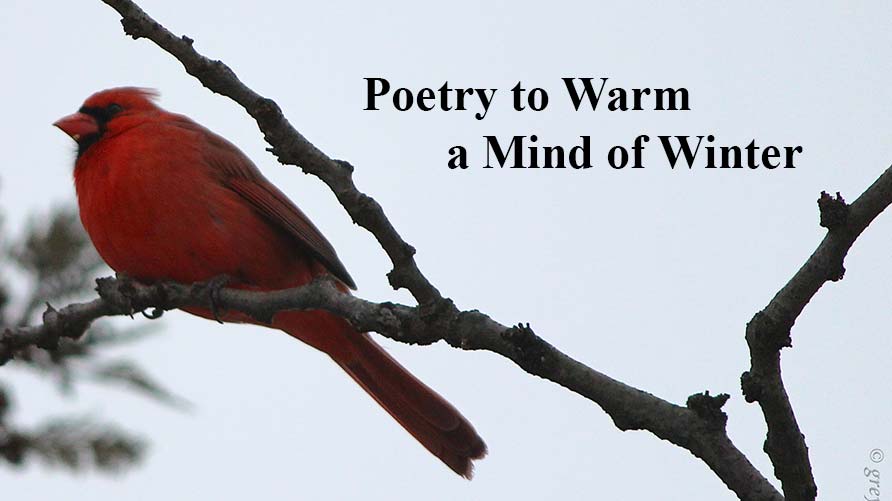
Poetry to Warm a Mind of Winter: Photograph of a Cardinal on a Branch. Photo credit: James H via Flickr, Creative Commons License 2.0.

I don’t know about you, but I’m aching for spring already. Here are poetry readings that will bring us in March, which is almost spring in New England. Thanks as always to Daniel Bouchard for publishing these listings. Follow him on Twitter. I’ve also discovered Lori Desrosier’s site, which posts poetry news in Western Mass. And a series in Shelburne Falls not listed below called Collected Poets.

Of special note below:

  • Tamiko Beyer at home.stead in Dorcester
  • Carla Schwartz at the Old Manse and home.stead
  • Martha Collins at Arts at the Armory Somerville and the Brookline Public Library
  • Jericho Brown at Smith
  • Joan Houlihan in Hopkinton
  • Zara Raab in Newburyport
  • Daniel Bouchard’s MIT Reading Series

Continue reading “February and March 2020 Poetry Readings in Boston and Environs”

Dispatches from an MFA: Semester Two, Third Packet

This is part of a series called Dispatches from an MFA, which details my experiences in the low-residency MFA program at Lesley University. In the second semester, I studied with poet Kevin Prufer. We spent the semester looking at narrative versus lyric poetry. This is the cover letter to the third packet.

Dear Kevin:

As you pointed out, the critical work in my last packet was a little thin. I hope I’ve redeemed myself with this one. It’s always possible to do more with grad school work, but I feel confident that I’ve given sufficient time and attention to James Wright’s and D.A. Powell’s work. I read your essay on Powell, and am glad that I did so after finishing my own paper. It can be difficult for me to approach a text with any kind of original thinking after reading another’s interpretation. I think you managed to say with more perspective and eloquence some of the things I was trying to say in my own paper. I especially appreciated the parallels the death-dancing German painting and Powell’s exuberant music. I hadn’t really paid attention to Powell’s exploration of spiritual redemption in Cocktails – especially in the Bibliography section – but can see it clearly in hindsight.

Continue reading “Dispatches from an MFA: Semester Two, Third Packet”