instead of a book
she made a baby. he feeds
on her while we talk
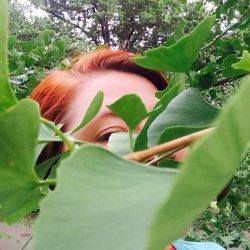
tended by poet Frances Donovan
instead of a book
she made a baby. he feeds
on her while we talk
 It’s national poetry month again. My website was briefly down because Gmail did such an amazing job of sorting my email for me, I never got the notices reminding me to renew the domain registration for Gardenofwords.com. That was a killer way to start off national poetry month.
I noticed the outage when I was pitching a website redesign to a poet whom I greatly admire. I’m fortunate to be able to pick and choose my clients in a way I wasn’t always able to in the past. As a result, my very short client roster is full of interesting, creative women. This latest client would probably point out that I am an interesting, creative woman myself, to which I respond “pshaw.” It’s nice to have friends who say complimentary things about you. In the Po-Biz, that’s how you get blurbs for the back of your book.
April has been surprisingly un-cruel in the past couple of days, especially given March, February, January, and December, all of whom I want to roll up into a big ball, flatten with a giant rolling pin, dry in the sun, and then fold into lots of sharp corners and stick up the posterior of this past winter. It’s very easy to forget that things are exponentially better for me today than they were this time last month, and the month before. Just the other morning I forgot about it while packing my lunch. M. and I got into a lively discussion* about his tactical decision to forgo buying lettuce on Monday night rather than buying me non-organic lettuce which I might not eat. It wasn’t about lettuce, of course. It was about my own severe anxiety at having less than $10 in my checking account the day before I got paid. And the very uncomfortable dynamic that develops when two people fall in love and move in together, and then one of them takes a hefty pay cut.
On the plus side, we worked it out, as we always do. I’m continually amazed at M’s ability to handle situations that have baffled me for most of my life. Emotional intelligence comes in all kinds of packages — some of them former infantrymen. Also on the plus side, I’m steadily plugging back up the hill toward a full-time work schedule. Also also on the plus side, I took a walk yesterday afternoon and TOOK OFF MY COAT. And didn’t put it back on once. Which just goes to show you anything is possible.
Spring is late this year, but it’s here. The hills are still grey and brown with bare trees, but the moss has turned bright green and the grass won’t be far behind. Snowdrops have been out for weeks now, lingering in the cool spring air. Crocuses are here, and may even be gone in another week. The daffodils in my back garden have been poking their little green heads up. Ralph chases the squirrels until well past 6:00 pm.
Poetry-wise, I’m doing less and more than I’ve done in years past. Whereas in past years I’ve adhered to a strict regimen of a poem-a-day, I find myself moving more fluidly now. I’m making inroads into new techniques for revision, attempts to cut away the dross and find surprising turns of phrase. A sort of Orb-style remix, but with random poems instead of sound clips.
The bout of illness and the 40th anniversary of my birth made me stop and think about what I’m doing with my life, and if it’s what I want to be doing, and what I can do about all that. When I’m very ill, I will often decide that This One Big Change is what will fix all of my problems. Past experience has taught me that it usually just creates more instability and makes it harder to get back to a baseline. A cursory search of the Intartubes (“year of the horse” plus “horoscope” plus “2014” plus “water ox”) gives me highly scientific** evidence that this is not the year for me to make any sudden changes. In the Year of the Horse, things gallop along. You might find yourself miles from where you started, only to discover you’ve gotten on the wrong horse. For a person born in the year of the water ox (1973), it’s not a good year to be moving and changing. But it is a good year to send out hidden feelers under the earth, gathering information through the mycelium that binds us all together.
The seed inside unfurls with the longer days, reaching toward the light. I watch it, worry, pray it won’t be killed in an early frost. April is cruel in a different way every year. I am curious to know its cruelty this year, in the year of the horse. Maybe there will be a kindness to its cruelty, as I slog and toil and trudge into something warmer, something sunny, something else.
*which our neighbor could hear through the walls, no doubt
** and by “scientific,” I mean the opposite, of course
You ask me whether your verses are any good. You ask me. You have asked others before this. You send them to magazines. You compare them with other poems, and you are upset when certain editors reject your work. Now (since you have said you want my advice) I beg you to stop doing that sort of thing. You are looking outside, and that is what you should most avoid right now. No one can advise or help you–no one. There is only one thing you should do. Go into yourself. Find out the reason that commands you to write; see whether it has spread its roots into the very depths of your heart; confess to yourself that you would have to die if you were forbidden to write. This most of all: ask yourself in the most silent hour of your night: must I write? Dig into yourself for a deep answer. And if this answer rings out in assent, if you meet this solemn question with a strong, simple “I must,” then build your life in accordance with this necessity; your whole life, even into its humblest and most indifferent hour, must become a sign and a witness to this impulse.
— Rainier Maria Rilke, Letters to a Young Poet. (tr. Stephen Mitchell) Vintage Books, New York: 1984.

November is many things: my least favorite month of the year, one long sugar hangover between Halloween and Thanksgiving, the void into which the long evenings of autumn light become the sudden dusk of winter nights. It’s Movember, when men, women, and cars sprout moustaches to remind us that men should have shower cards too. It’s National Novel Writing Month (or NaNoWriMo for those of us too hip to pronounce entire words). It’s Grateful November. In 2010, it was my own NaPoWriMo for about four days.
All of these 30-day, month-long commitments, all of these mutually supported do-good movements are great. They’re wonderful. They’re a sign of the in-gathering that is winter in the northern hemisphere: after the expansive summer and the exhausting harvest, the drawing together of the tribe around the fire to tell stories and… tweet about how many words they’ve written.
And for a perfectionist like me, they can also be a huge set-up for over-commitment and failure. Historically, November has been the worst month for me to do just about anything but plod along and show up day by day. The body knows this very well, but the mind forgets on a regular basis.
So this November, I resolve to do everything imperfectly. I will get my ass out of bed on a daily basis — imperfectly. I will express gratitude imperfectly, sometimes with mere gestures and sometimes with more sincerity. I will write haiku and journal imperfectly. I will update this blog imperfectly–perhaps weekly, perhaps less. I will join in the Dverse Poets community when it’s reasonable for me to do so, not each and every week, no matter how many times my calendar reminds me to.
I will conduct the next two sessions of my writing workshop imperfectly, doing my best to inspire and be inspired, enjoying the unfolding relationships developing among us all– and feeling lucky to be teaching writing, something so near and so dear and so close to my heart.
Imperfectly, I will accept the blessings and the gifts each day has to give me. And I will forgive myself for my own imperfections, give myself as many breaks and second chances as I need, and relax about whether I’m doing my imperfect November as imperfectly as I would like.
The new writing group met last night for the first time. I’ve done my best to appear confident about this new venture, but anyone who knows me well knows the turmoil of the waters beneath the placid surface. Facilitating workshops is not new to me — I’ve done it in various venues and for various years for more than 20 years — but this particular project lies quite close to my heart. Fear of failure and fear of success dogged my steps in the months leading up to its opening.
I feel particularly grateful for the love and support of my two teachers: Toni, who first challenged me to consider the possibility of starting a workshop similar to his, but on the opposite side of the Boston hub. He’s provided support both practical and spiritual — and will no doubt continue to as my own confidence waxes and wanes. And Barbara, whose workshop sparked the necessity of finding a place to generate new stones to polish and polish under her guidance. She said to me, “My first workshop was two friends who were there for free, and one person who paid $40.” That was 30 years ago, and 125 books and countless journal publications have emerged from her workshop since.
This time last week, I was reciting a litany of fears to Toni, and he responded — as he often does — that the universe would give me just what I needed, moment by moment. Last night, that was a small group which merged effortlessly. And a group decision to focus on generating works of poetry, the form I am concentrating on myself. In three hours we worked four different prompts, and by the end of the evening we felt expansive and full of possibilities.
We meet again in two weeks, when two more new members will join us. We have space for a few more, but whether the group stays small or expands to capacity, I’m sure the universe will provide just what is needed.
Two years ago I read a piece in the Sun Magazine by a woman named Brenda Miller called The Burden of Bearing Fruit. It was the sort of article one finds there a great deal: a personal essay, contemplative, sometimes rambling, with a flash of beauty — a surprise tie-up, an effortless making-sense of daily objects and events. The making-sense of art, which tells the true but tells it slant.
These essays often shame me in their seeming effortlessness in the same way that Martha Stewart shames wives and mothers all across America, or the way Oksana Baiul shames 12-year-old figure skaters. In my saner moments I remember that the authors of these essays (often English professors or professional writers) probably went through multiple drafts, worked and worked on each word and sentence, considered the form and flow of the piece, perhaps the thesis and the theme. In my less sane moments I wonder why my own work doesn’t appear in The Sun’s pages. Never mind that I’m focusing on honing my craft in poetry right now, not personal essays. Or that I have a full-time job writing meeting minutes and functional specifications. Why am I not better at it by now? Where is my Harvest-themed centerpiece? Where is my triple lutz?
But let me, for the sake of this moment, put aside those inner critics. Let me even put aside the notion that I might beat that little hater. And let me return to that phrase which has stayed with me for two years and more: the burden of bearing fruit. Miller describes her own complicated relationship to the cherry tree that graces her property. You’ll have to read the essay to catalog its full meaning, but what stays with me is the notion that as the tree ages it is released from the burden of bearing fruit. Approaching 40, years into an artistic recovery I can barely discuss without weeping, I’m well aware of this burden. The terrible secret of farming and gardening is that bringing in the harvest is just as difficult as the plowing, the sowing, the planting, and the tending. Once the fruit arrives it must be picked, it must be eaten, it must be shared, it must be preserved and set away for the winter. Some of it always rots.
My tree has blossomed and begun to bear fruit. This evening I read at the Newton Free Library and the day after a brand new workshop begins meeting in my home. It’s not the first time I’ve read to an audience, not the first time I’ve led a workshop, but the burden of bearing fruit remains. Perhaps this time the harvest will be more sustainable.
I just discovered that I am scheduled to read at the Newton Free Library on Tuesday, October 8 at 7pm. I’m so glad that Barbara at PoemWorks reminded me that Doug Holder had asked me to read for the series way back at the end of last December.
My reading is the day after the monthly PoemWorks reading at Newtonville Books. The following evening (Wednesday, October 9) I begin facilitating a writing group that will meet every other Wednesday through the beginning of December. So it’s going to be an all-writing kind of week for me.
Next month (Tuesday, November 12), two poets I know personally and greatly admire — Alexis Ivy and Charles Coe — will also be reading at the Newton Free Library. From the descriptions of the two folks scheduled to read with me on Tuesday — Wendy Ranan and Lawrence Kessenich — I will be in quite illustrious company myself. An open mic follows the reading.
If you are in town I would love to see you there. I know some of the Dverse Poets are Bostonians and would love to meet you in person. Directions by car and public transit are on the Newton Library website. Either way, wish me luck. It’s been some months since I’ve read in front of an audience.
 All forms welcome: poetry, prose, fiction, non-fiction, memoir, truth, and beauty.
We will focus on creating a supportive environment for generating new work until the group has established enough rapport for meaningful critique and revision.
We will also share experience and strategies for sending out work for publication.
First term meets 6:30-9:30 pm, every other Wednesday, Oct 9-Dec 4.
Fee is $150 for the entire term, payable in advance. You are welcome to attend one session as a guest to see if it is the place for you.
The workshop will be held in a private home on the 51 bus line between Forest Hills and Cleveland Circle. Parking is also available.
Space is limited so sign up soon.
Frances Donovan’s work has appeared in Lyrical Somerville, PIF Magazine, The Writer, Perimeter, and The dVerse Anthology: Voice of Contemporary World Poetry. She curated the Poetry@Prose reading series in Arlington, MA and is a member of PoemWorks: the Workshop for Publishing Poets. She also affiliated with Toni Amato’s Write Here Write Now workshop in Somerville, MA. You can find her online at www.gardenofwords.com
For more information or to sign up, use this contact form.
My longest poem, “Letters from Provincetown,” has gone through a number of iterations since I first penned it in 1998. And now it’s been included in the newly released dVerse Anthology: Voices of Contemporary World Poetry.
Edited by Frank Watson (aka Follow the Blue Flute), the volume contains work from poets who frequent the dVerse Poets Pub, an online community that I find has a nice balance between friendly members and quality work. I’ve made a number of helpful connections at their weekly Open Link Night and also enjoy their other regular series, including Form for All and Pretzels and Bullfights.
A friend recently chastised me for downplaying my accomplishments. So if you’d like to support my work and also read an interesting variety of voices from around the world, I suggest giving it a look. The book is available in print and ebook at Amazon and debuted in the top 20 poetry anthologies on the site.
Buy the book here: http://www.amazon.com/The-dVerse-Anthology-Voices-Contemporary/dp/1939832012


 Garden of Words