
the clouds part, and then
this opening at Imbolc
carries me to March
Poet to Poet: Doug Holder Interviews Alexis Ivy
Alexis Ivy is a poet I greatly admire. We spent some time together in the same workshop and I’ve really enjoyed her first book Romance with Small-Time Crooks. Doug Holder of Ibbetson Street Press interviews her here on Somerville Community Access Television.
In case the embedded video above fails, here is a direct link to it on YouTube.
Twenty-two Degrees and Windy Haiku
sun slants over snow
dyed vanilla by the light
of mid afternoon
Boston Area Poetry Readings for January and February 2016
January always feels like a holiday hangover to me. So far, the temperatures are bracing cold and the skies clear — two good signs after last February’s record snowfalls. Please Skadi, send us enough snow for snowshoeing and not enough for epic shoveling. Daniel Bouchard sets us back on the path of poetry with the listings below. All locations are in Massachusetts (USA) unless otherwise noted.
My poetry workshop in Roslindale, MA also reconvenes in February. Priced for starving poets, focused on generating new work.
Friday, January 8, 7:30 pm
Dan Johnson, Deborah Melone, and Jan Schreiber
Chapter and Verse
Loring-Greenough House
12 South Street
Jamaica Plain Centre
Saturday January 9, 3 pm
Elizabeth J. Coleman and David Berman
Powow River Poets Reading Series
Newburyport Public Library
94 State Street
Newburyport, MA
Free and open to the public
Continue reading “Boston Area Poetry Readings for January and February 2016”
Halfway to Imbolc Square Haiku
what a difference
an extra hour of sun
creates within
Cardinal in December Haiku
a flash of red wings
sudden against the gray sky
buoys my winter heart
Boston Area Poetry Readings for December 2015
These listings are compiled by Daniel Bouchard. Friday, December 11 is the very last of the BASH Reading Series by Black Ocean Press at Brookline Booksmith. And make sure to check out the Brookline Public Library on Sunday, December 20, where the open mic is as high-quality as the featured reader.
Thursday, December 3, 7 pm
David Miller, Sandra Storey and open mic
Rozzie Reads
Roslindale House
120 Poplar Street
Roslindale, MA Continue reading “Boston Area Poetry Readings for December 2015”
Cultural Appropriation and Fair Use
When the 2015 collection of Best American Poetry came out this September, the poetry world erupted into controversy. At the crux of the matter was a poem titled “The Bees, the Flowers, Ancient Tigers, Poseiden, Adam and Eve” by Michael Derrick Hudson. Why all the fuss? Because Hudson, a white man, published his poem under the pen name Yi-Fen Chou. Hudson claimed that he was unable to find a publisher for his poem until he began sending it out under an Asian pen name (1). Asian poets and writers were understandably upset when the anthology came out and it’s sparked a discussion among academics and poets about the nature of cultural appropriation and the myth of reverse racism. Editor Sherman Alexie responded to the controversy in an article posted on the Best American Poetry blog. His thoughtful essay addresses the tension between the literary world’s desire to showcase diverse voices and the necessity of remaining faithful to aesthetic principles:
“If I’d pulled the poem then I would have been denying that I was consciously and deliberately seeking to address past racial, cultural, social, and aesthetic injustices in the poetry world.
And, yes, in keeping the poem, I am quite aware that I am also committing an injustice against poets of color, and against Chinese and Asian poets in particular.
But I believe I would have committed a larger injustice by dumping the poem. I think I would have cast doubt on every poem I have chosen for BAP. It would have implied that I chose poems based only on identity. (2)”
My own experiences as a queer woman and my friendships with people of a variety of races and nationalities have sensitized me to the issue of cultural appropriation. So what is cultural appropriation? It’s overwriting the voices of the voiceless with narrative constructed outside of the lived experience of a person who is a member of an oppressed class. Since there are many kinds of oppressed classes and since one person can belong to more than one of them, the issue can become complicated. The litmus test for me goes back to the question of lived experience. Does the person telling the story have the right to tell it? Is it his story to tell? As with many questions, there is no one right answer, but there are definitely some wrong ones.
“The Kitchen Poem” in the Summer 2015 Issue of Dirty Chai
This spring I was delighted to learn that “The Kitchen Poem” had found a home at Dirty Chai Magazine. I missed the issue when it came out, so here it is now. Here’s a PDF download of the Summer 2015 Issue of Dirty Chai.
And since it’s more 90 days since it appeared there, here’s a reprint:
The Kitchen Poem
for Adrienne Rich
A kitchen is where a woman belongs sometimes
not because I should cook for you
but because here when one sits at the table
with a bowl of something one realizes
what it is to slow down
Because here there is always food
and yet I can go hungry
Because there is a smell of things cooking,
and the smell is good.
Because I can spread tablecloths
and be unmolested.
Because God loves a kitchen
and I feel powerful here.
Because a kitchen is where civilization began.
Because some men are shy of the kitchen
and those men I can do without.
Because kitchens come in many shapes and sizes.
Because Allen Ginsberg never wrote a poem about a kitchen.
Because in a kitchen, a woman can take what has been
dismembered,
forgotten
and remember it.
Because in a kitchen we put things together
that have been cut apart
and call it food.
Interview with Poet Lesley Wheeler, Author of Radioland
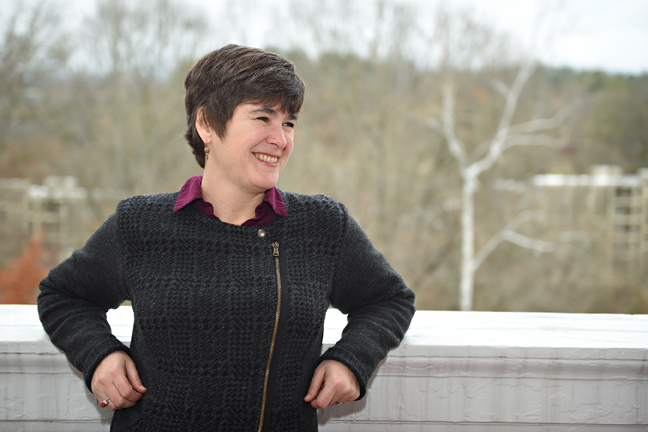
A much-decorated poet and academic, Lesley Wheeler’s accolades include a Fulbright scholarship, an NEH grant, the Barrow Street Poetry Prize, the James Tiptree, Jr. Award Honor List, and publication in many prestigious journals, including Poetry and Slate. She teaches English at Washington and Lee University and is an active member of the WOM-PO Listserv, an email discussion group for women poets that’s been around since before blogging and social media overtook online community platforms like Listservs. Her third book of poetry, Radioland, came out in October 2015. In spite of her rise to fame in recent years, Lesley remains a warm and generous correspondent. She took the time to answer some questions about her latest book, the po-biz, and the difference between writing and publishing.

You’ve gotten a lot of recognition for your work in the past few years. How have these changes in your career affected your writing?
It’s funny how happiness works—successes don’t warm you for long but difficulties worry you constantly. The life change came with my first two books, Heathen in 2009 and Heterotopia in 2010. Suddenly I felt able to call myself a poet. After the Barrow Street Press Poetry Prize, people seemed to take my work more seriously. The judge, David Wojahn, is highly respected by other writers, and that made a difference. “Fulbright” is a magic word—as well as representing an amazing opportunity—but I won that for scholarly, not poetic, research. My scholarly credentials remain fancier than my poetic ones and the two networks have surprisingly little overlap. In fact, having a foot in both worlds invites suspicion from both sides.
Continue reading “Interview with Poet Lesley Wheeler, Author of Radioland”
 Garden of Words