last leaves on the vines
russet and brown, dangling
above the garage
(give yourself permission to write bad poetry)
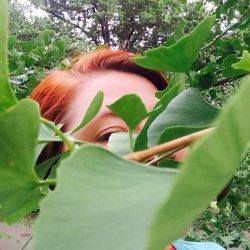
tended by poet Frances Donovan
last leaves on the vines
russet and brown, dangling
above the garage
(give yourself permission to write bad poetry)
Of all our holidays, Samhain is the most obviously pagan in its origins. Halfheartedly assimilated by Christians as Halloween (or “All Saints’ Day” for the truly pious), the focus on the underworld — on death and dying — is hard to reconcile with a tradition that promises everlasting life.
The thing that makes this holiday essentially pagan is its acceptance and observance of death as a natural part of the cycle of existence. Like the Death card in the Tarot, it does not mean stagnation and decay. Rather, it symbolizes the difficult yet rewarding pain of transformation — think of a snake shedding its skin. At Samhain, we shed the remains of what we’ve harvested in the previous year and turn toward the inner work.
It’s a time of endings and beginnings. With darkness encroaching but not complete, it is the twilight time — not one thing nor another. In the half-shadows of the shorter days, with the final flare of the summer sun alive in the changing leaves, and the chill of late autumn in the air, we become aware of the thinning veil between this world and the next. We remember those who have passed before us, grieving their passing and celebrating the brightness they have brought to our own lives.
This October as we strolled under a corridor of yellow leaves, I bemoaned the passing of summer’s warmth and light to a friend.
“Maybe it’s important to focus not just on what’s passing, but on what’s germinating,” she replied. “This is the time of year for apples, and cider, and gathering inside with your tribe around the fire.”
As I continue through a major life transition, I see my tribe changing and shifting. I’ve had to shed some things in order to make room for others. The empty spaces leave me trembling and terrified. But even as I weep and grieve, I see how the Goddess fills those spaces with new life, new energy. I look ahead to what is germinating, trusting in the the wisdom of all the crones who have gone before me, and who gather with me now behind the Veil.
Gratitude is a practice that grows with use, strengthens as it gets stronger, spills out of the heart and into the world. Reciting the same dry words over and over again does not suffice. I need to write it down, seek out the new, let the words and associations spill out of me, touch each other off, tiny candle-flames coalescing until they’re blazing through the darkness.
As the days grow shorter, the trees flare and drop and reveal their bare architecture, my sap flows downward into silence. Under the snow, summertime slumbers. My mouth tied up with cobwebs and leaf mold, and underneath the filaments that hold the soil together, erupting after rain into white shoots of mushrooms — Indian paintbrush.
Three weeks ago, I struggled through unexpected traffic, late to a too-early appointment, left my car in its spot too long while the ignorant hounded me and I turned them tai-chi-like into pupils, and when the work was done and I could raise my head, I left the building to find my car half-hoisted in the joist of the tow truck.
I knew what came next. You don’t live in a city like Boston for ten years without knowing what came next. I danced the dance, said my lines, pleaded for mercy, failed to weep or gnash my teeth when the greasy man said, “Fifty dollars. Cash.”
Slaves who had become kings. I opened my wallet. No cash, but a card, and he would wait while I went to the ATM. Two twenties and a roll of quarters later, I was free, some buried part of me seething, sure, but the rest of me remembering how, in years past, I’d done the endless drive to industrial waste-yards, paid the fee and then the fee again, seen the greasy kings boasting about their orchards of waiting cars, the kings of trespass towing.
Learned the hard way that keeping my papers in order was not optional. Plodded to the other halls of justice, gave this paper-stamper and then that one my money more money always more money, watched my bank account wither past zero and into the land of deprivation, trying not to worry, not knowing what would keep me in the freezing room I rented with three others in Cambridge, eating lentils and rice in a cold winter porch, trusting in an unknown abundance despite the evidence.
And on that afternoon I saw the fruit of all that suffering.
Fifty dollars is a fortune when you have to it give to the miserable man in his miserable truck, and can be free to drive, comfortable and warm, through the bright autumn afternoon.
From the archives, a character study I started in 1998. Would you like to hear more of her story?
In Pura’s voice
She turned out to be just like all the other bitches. After all I did for her, she just cut me off. All those good times we had, those long drives in the country, all the times I took her out to dinner, nothing. It meant nothing to her. She just wanted to see how much she could get out of me.
I should have known better when I met her. She was alone, standing against the wall at the club when I saw her eyeballing me, dancing. I could see her eyes shining in the darkness. Demon eyes. I didn’t let on that I noticed her, just kept on dancing. But later, I eased on up next to her. She leaned down to me, like a fly to honey. I pulled her onto the floor. And she could dance. Really something for a white girl, for a pale-skin like her to dance like that. I did like her pale skin, too, all creamy, but dotted with beauty marks. That blonde hair, those blue eyes. But I’m getting ahead of myself.
I got up to close the window
and saw her
she was spinning in the yard
and painting the leaves on my treessorry I was late
— Kellie Elmore, Autumn’s Apology
September colors
rusting along the highway
meridian changes
When you neglect your work
it’s like a mine disaster
I think of all the people
trapped inside you
(after Richard Brautigan)
Menotomy lands
orange leaves upon a single tree
first sign of autumn
shrill drone of insects
green lawn dappled by sunlight
and wind in the leaves
This review of Dark Tide: The Great Boston Molasses Flood of 1919, by Stephen Puleo is re-posted from my Goodreads feed.
In January 1919, a 2.3-million-gallon tank of molasses located in Boston’s bustling North End burst, wreaking death and destruction in its wake. Most people — myself included — laugh in disbelief when they first hear of the incident. But the towering wave, which traveled at 35 miles an hour, claimed the lives of 21 people, and transformed the North End into a moonscape, was deadly serious. Puleo does an admirable job of extracting a living tale about this event from dry court records and newspaper accounts.
The circumstances of its construction, its failure, and the criminal and civil trials that followed all serve as a focal point for the major forces sweeping through the country at the beginning of the last century, including industry’s increasing footprint on the American economy, the impact of World War I and the Prohibition, corporate negligence, and the radical anarchist movement.
Puleo’s book focuses on the lives of the individuals surrounding the case — not the major historical figures we usually read about, but the ordinary people who lived and worked in the North End neighborhood, built the molasses tank, managed the plant, and investigated the disaster afterward. His storytelling is grounded in primary sources but manages to bring alive an event that happened almost 100 years ago and had a profound impact on the way business is conducted today.
A while back, a friend of mine posted on Facebook that she wanted to indulge in some “emo femme shopping,” but that she was resisting the impulse. And she summed up the post with a phrase I wish I were uninhibited enough to write: “world love me NOW!”
I knew immediately what she meant. This friend and I have a lot in common. We’re both queer femmes, we’re both plus-sized girls, and neither of us had Mrs. Cleaver for a mother. Her post also made me aware of how I’d been indulging in my own emo femme shopping for quite a few weeks. And what, pray tell, is emo femme shopping? It’s an attempt to lift one’s mood via the purchase of a pink/fluffy/sparkly/cute/fashionable item. And given the nearly unlimited number of pink/fluffy/sparkly/cute/fashionable items available via the miracle of the Intartubes and Paypal (not to mention the nice bump in salary I enjoyed when I came back to work full-time this April), it can reach dangerous proportions.
I’m sure we’re all familiar with the phenomenon of attempting to change our moods via some outside mechanism. Some of us use booze. Some of us use food. Some of us use sex. And some of us use things like this! or this! or this!. I’m actually not very interested in any of these items, but they do a good job of representing the kind of twee, impractical things I tend to crave when I’m in a particular kind of mood.
Emo femme shopping can very quickly turn into the hell of the hungry ghost — a hell of intense craving that’s impossible to satisfy. A tiny mouth and a huge belly. Like most hells, it’s an illusion. In this case, it’s the illusion that more material possessions will fill the god-shaped hole inside of me.
Continue reading “Emo Femme Shopping and What It Won’t Give Me”

