Gloria Mindock Talks About the Cervena Barva Press Reading Series

Gloria Mindock has been a fixture of the Boston literary scene for decades. In addition to running Cervena Barva Press and The Lost Bookshelf, she offers multiple reading series throughout the year. An accomplished poet in her own right, she is the author of six poetry collections, most recently Ash from Glass Lyre Press. Gloria’s poetry has been translated into 10 languages, and has appeared in numerous literary journals including Poet Lore, Muddy River Poetry Review, and Nixes Mate Review. Among other accolades for her service to the poetry community, she was the Poet Laureate of Somerville, MA in 2017 and 2018.

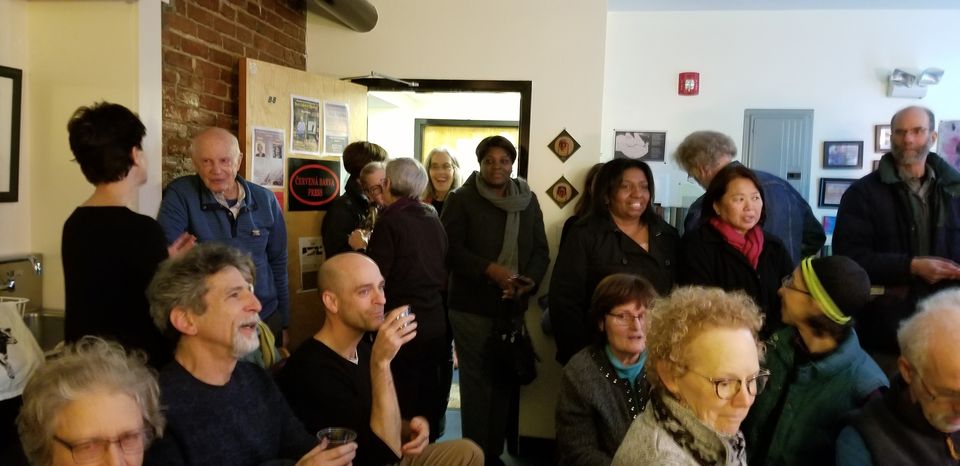
Gloria took the time to speak with me about the readings she offers at the Cervena Barva’s space at Arts at the Armory in Somerville. Since the pandemic began, she has moved her series online.

Does your series happen on a regular schedule, such as the second Tuesday of the month? If so, what is it?

I started out having the Cervena Barva Press reading series on Wednesdays but since I have my own space (Arts at the Armory, Basement B8), I am flexible and schedule readings when the readers are available. It is wonderful to not depend on other places for scheduling.

Before I had my own space, I had the series at the Pierre Menard Gallery in Harvard Square. I loved having it there. It was such a beautiful space and easy for people to get to. John Wronoski and his staff were the best! The gallery is no longer there.

How did this reading series come about?

I wanted to give my authors a place to read as well as other writers in the community and the world.

Continue reading “Gloria Mindock Talks About the Cervena Barva Press Reading Series”

A Poetic Variety Show: Talking with Steven Cramer, Author of Listen

Steven Cramer taught one of the first seminars I took at the Lesley low-residency MFA program, and I later learned that he founded the program itself back in 2003. Like most of the Lesley faculty, his bio is studded with accolades: six books of poetry, a page on the Poetry Foundation website, prizes from the New England Poetry Club and the Massachusetts Center for the Book, and bylines in major publications like Poetry, The Atlantic, and The Paris Review. But perhaps more importantly, he’s a sensitive soul with a deep and comprehensive knowledge of literature. When I was writing a craft essay on Dickinson, I went searching for interpretations of a particularly obscure line, and an interview with him was the only relevant result.

His newest book Listen (Mad Hat Press) came out in 2020 amidst all the chaos and isolation of the pandemic. Fortunately, Zoom readings have in many ways made poetry even more accessible than before. And writers often prefer to communicate using the written word. Steven and I corresponded via email for a few weeks, with prodigious results. We discussed the ways that poetry collections come together, the pros and cons of printed page versus screens, and white space as a craft element. And, as I do with every poet I interview, I asked about his individual writing practice, the ways he manages the writing life, and what he might tell poets at the beginning of their careers.

Frances Donovan: Tell me about your new collection.

Photograph of poet Steven Cramer
Poet Steven Cramer

Steven Cramer: Listen was a peculiar collection to assemble.  My previous book, Clangings, arrived in a kind of white, interruptive heat between 2010 and its publication in 2012.  By the time I’d written enough poetry for Listen, some candidates for inclusion in the book dated as far back as 2004, and others came of age as recently as two years ago.  How did these poems talk to each other, if they did?

I was never much good at organizing my own books. I always asked my friends for help.  I had poems that wrestled—sometimes rather covertly—with three years of depression; those had to go together.  I had poems that cast imaginative attention on my different clans—children (tweenish in 2004; by 2019 in no way children); a thirty-plus year marriage; the absences and presences of my diminishing family of origin; and reading, a subject I embrace without apology. With crucial assistance I came up with a first section that starts very dark, goes darker, and then begins to lift its gaze before the second section turns to the erotic life and two of its inevitable outcomes—offspring and death!  A number of poems that grapple with the social world’s impingements on the personal had accumulated for a third section. Finally, there’s a group that, by and large, honors writers I love, through adaptation or homage. I think that last suite completes the upward arc from Listen’s first section. 

Continue reading “A Poetic Variety Show: Talking with Steven Cramer, Author of Listen”

The Braid, by Carla Drysdale

First, my cry, then yours, split the sky
above that Brooklyn hospital
as you, limbs curled and purple
slid out of my body
after a prolonged and irreversible journey.
Pain, then
absence of pain.

The midwife held you up,
newborn body, alive in this world.
You peed an arc of urine
sparkling over the bed
and over her.

The champagne cork popped.
We all drank to life.
You suckled on a nipple.
Your lips still rimmed
with watery blood from that
other life inside.

We lay together, suspended,
holding on to each other.
Tough braid of blue and red
still binding us
cut for the first and last time.

From All Born Perfect, by Carla Drysdale. Published by Kelsay Books. This poem first appeared in the chapbook Inheritance from Finishing Line Press. Republished with permission of the poet.