March and April 2019 Boston Area Poetry Readings

Poetry and all that jazz

Expect lots more listings to arrive before National Poetry Month begins in April. March’s reading listings are rather rich as it is. Thanks as always to Daniel Bouchard for compiling these listings. Feel free to comment with your own announcements below, or submit your event for listing on the Mass Poetry website.

CLICK HERE FOR AN UPDATED LIST OF APRIL 2019 READINGS

Friday, March 1, 7 pm
Paula Bonnell, David Miller, Steve Rapp
The Old Manse
Concord, MA

Sunday, March 3, 1 – 3:30 pm
Tony Brown and Dzvinia Orlowsky
Poetry: The Art Of Words
Plymouth Public Library/Otto Fehlow Room
132 South St
Plymouth, MA

Monday, March 4, 8 pm
Mark Halliday and Adrian Blevins
Blacksmith House Poetry Series
56 Brattle St.
Cambridge, MA
$3

Continue reading “March and April 2019 Boston Area Poetry Readings”

Song and Compression in Emily Dickinson’s Poetry

Photograph of poet Emily Dickinson

Last semester I wrote a craft annotation on the subject of poetic structure and nonlinear time. Now I can see that this is very much an element of lyric poetry. Where narrative poetry moves like a road, lyric poetry unfolds like a flower, spiraling out from a single image or moment into a flurry of associations and other moments.

In The Flexible Lyric, Ellen Bryant Voigt calls out compression and song as two characteristics of lyric poetry. Emily Dickinson’s poems feature both of these qualities prominently. Her poems have a basic pattern: quatrains with alternating iambic tetrameter and iambic trimeter lines. But the thing that set her apart from the dominant aesthetic of her time was the way she broke from the pattern. What her contemporaries might have called spasmodic, imperfectly rhymed, and lacking in form, we today consider a masterful interplay of meaning and music. Some of her poems adhered more closely to convention than others. Consider “Because I could not stop for Death” (poem 712):
Continue reading “Song and Compression in Emily Dickinson’s Poetry”

A Close Reading of “Elegy for My Father,” by Annie Finch

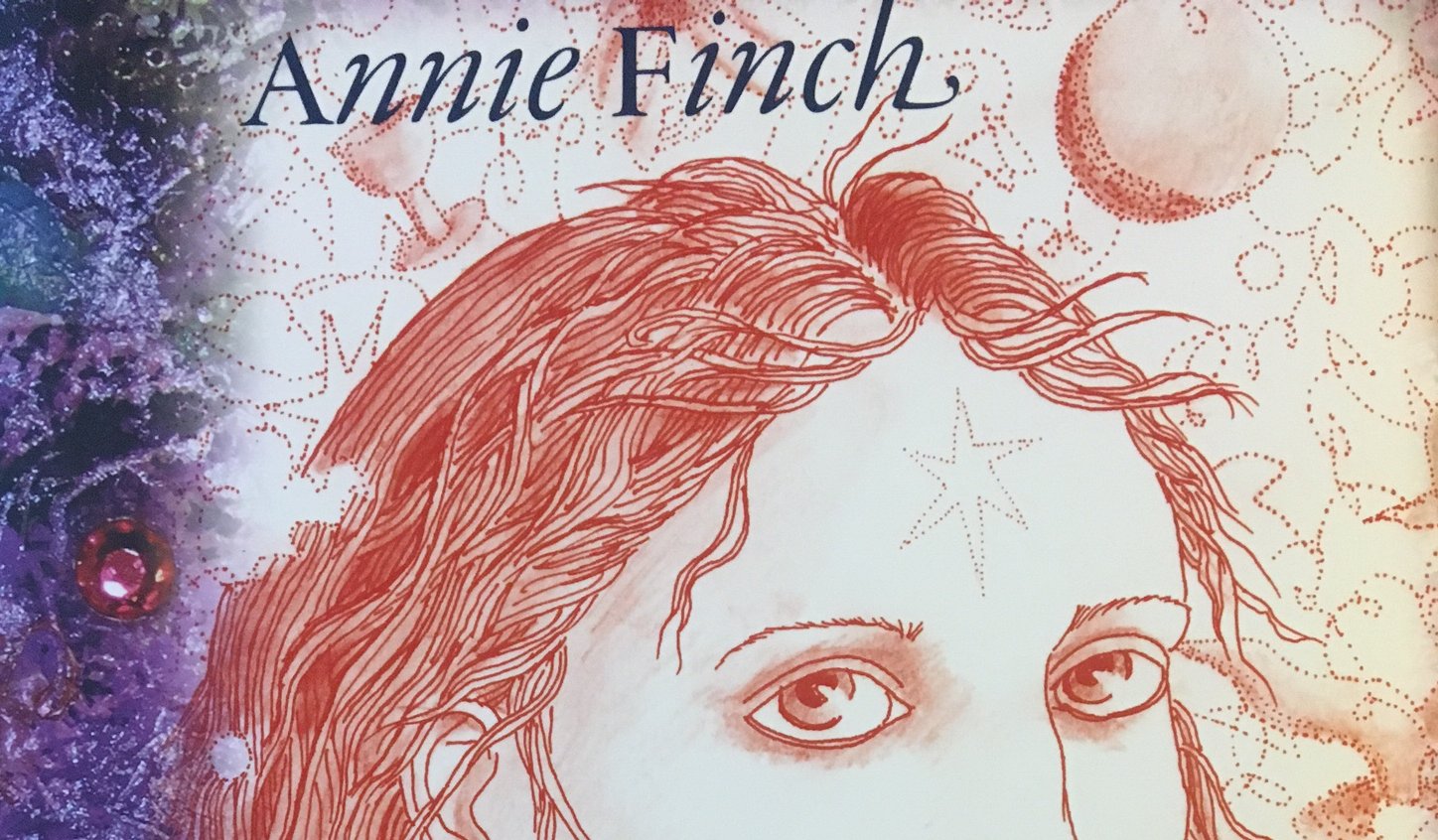
Detail of the cover of Spells: New and Selected Poems, by Annie Finch

Annie Finch titled her 2013 volume of selected poems Spells for good reason. A Wiccan as well as a poet, she recognizes the power of incantation in creating an altered consciousness, a state in which a strongly held vision can move from the realm of possibility into reality. Not all of Finch’s poems are visionary or transformative in intention, but they do share a powerfully persuasive incantatory quality.

Finch relies on a number of poetic techniques to create these incantations, most notably repetition of words and phrases and the use of iambs—the thump-THUMP of a heartbeat that calls up instinctive memories of the womb. But her repertory far exceeds the basic iamb, as we see in “Elegy for My Father.” While the poem definitely meets the criteria of an elegy – it recounts the vigil at her father’s deathbed – its complex dactylic meter runs counterpoint to the somber subject matter. Lines alternate between pure dactylic tetrameter and dactylic trimeter with a final, stressed syllable at the end, as in this example:

Continue reading “A Close Reading of “Elegy for My Father,” by Annie Finch”